Listen here on Spotify | Listen here on Apple Podcast
Episode released on November 12, 2026
Episode recorded on June 12, 2026
 Martyn Clark discusses applications of AI in hydrologic modeling, improving process representation across diverse hydrologic landscapes.
Martyn Clark is a Professor of Hydrology and the Canada Research Chair in Environmental Prediction at the University of Calgary. Prior to this position in 2023, Martyn was a Professor at the University of Saskatchewan and Associate Director for the Centre for Hydrology Coldwater Laboratory at Canmore. Martyn also served as Editor-in-Chief of Water Resources Research journal from 2017 to 2020. Martyn's research focuses on advancing environmental prediction, particularly how we can better forecast future water conditions.
Highlights | Transcript
- Comparison of Traditional Process Based Models and Data Driven Models
- Hydrologic modeling is at a pivotal transition—not from process-based models to AI, but toward integrating both
The recent HydroML Symposium held in Austin (May 19 – 21, 2026) included a panel discussion on the role of legacy models and how they can incorporate AI/ML approaches. Legacy hydrologic models require a fundamental redesign that separates physical process representation from numerical implementation, allowing machine learning (ML) methods to be integrated more directly in process-based models. The future lies in hybrid systems that combine scientific knowledge with data-driven approaches. - Legacy models have accumulated substantial "technical debt."
Many existing hydrologic models evolved incrementally over decades, with new components continually added by successive researchers. This has resulted in code that is difficult to maintain, test, modify, or extend. Clark advocates rebuilding models from first principles using modular architectures that are easier to evaluate and improve.
- Hydrologic modeling is at a pivotal transition—not from process-based models to AI, but toward integrating both
- Representing Hydrologic Diversity in Continental-Domain Models:
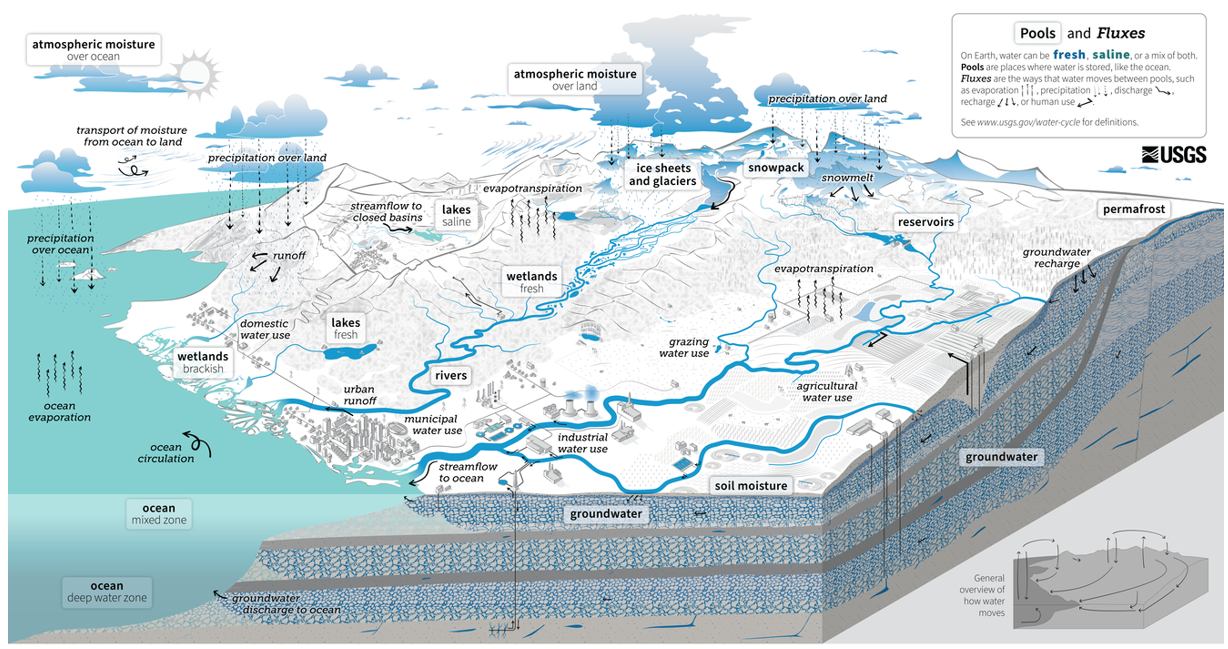
- The hydrologic cycle is complicated (Fig. 1).
- National water prediction systems require hydrologic models that simulate the wide diversity of hydrologic processes across the continent.
- Hydrologic landscapes provide a framework for understanding regional differences in hydrologic behavior.
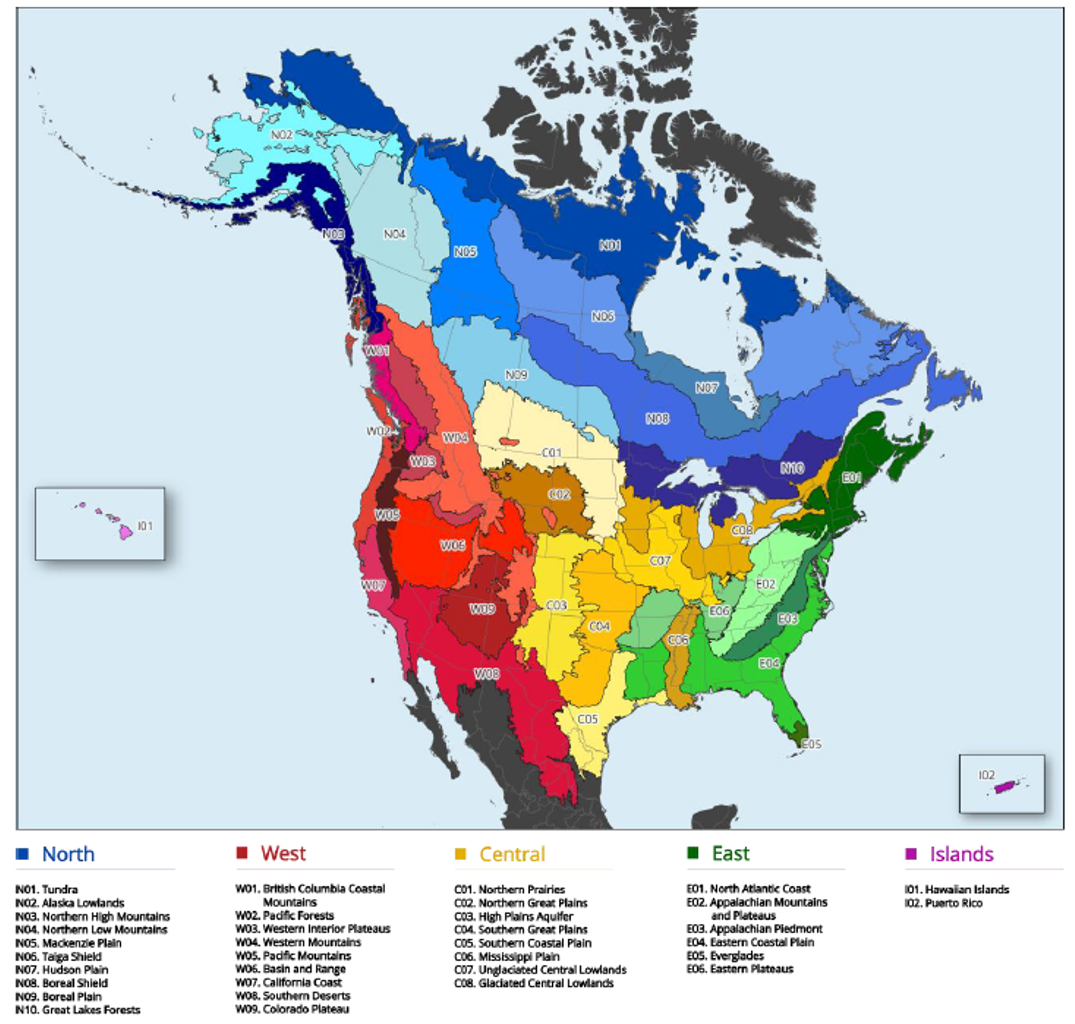
Through the CUAHSI/CIROH Hydrologic Landscapes project, researchers synthesized dominant hydrologic processes across North America, subdividing it into North, West, Central, East, and Islands (Fig. 2). The synthesis identifies how regional controls such as climate, geology, vegetation, permafrost, and human water use influence which hydrologic processes are important in different environments. - Many important hydrologic processes remain poorly represented in continental-domain models.
Clark highlighted several missing or oversimplified processes in continental models, including:- Prairie pothole "fill-and-spill" dynamics (dynamic changes in the contributing area of the catchment because the prairie potholes act as gatekeepers, and the area upstream of the prairie pothole does not contribute flow until the pothole is full)
- Tile drainage in agricultural landscapes,
- Losing streams in arid environments (term “teflon streams” refers to models not allowing streams to recharge groundwater in arid regions),
- Mountain block recharge, and
- groundwater-surface water interactions.
- Incorporating these processes is essential to improve the accuracy of national-domain water prediction systems.
- Landscape characteristics control hydrologic behavior through model parameters as much as through governing equations.
While conservation equations describing water movement are generally well understood, the greater challenge is determining how landscape properties influence storage, connectivity, residence time, and water release. Clark emphasizes that parameter estimation should be viewed primarily as a physics problem informed by landscape characteristics rather than simply a statistical calibration exercise.
- Incorporation of AI/ML into Hydrologic Models (Evolution of Hydrologic Modeling)
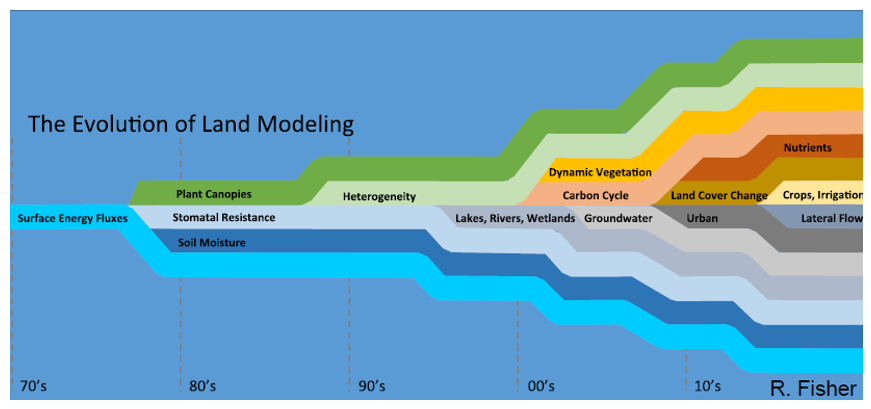
- Land models have evolved from considering the land surface as the lower boundary to the atmosphere to integrating land processes into these models (Fig. 3).
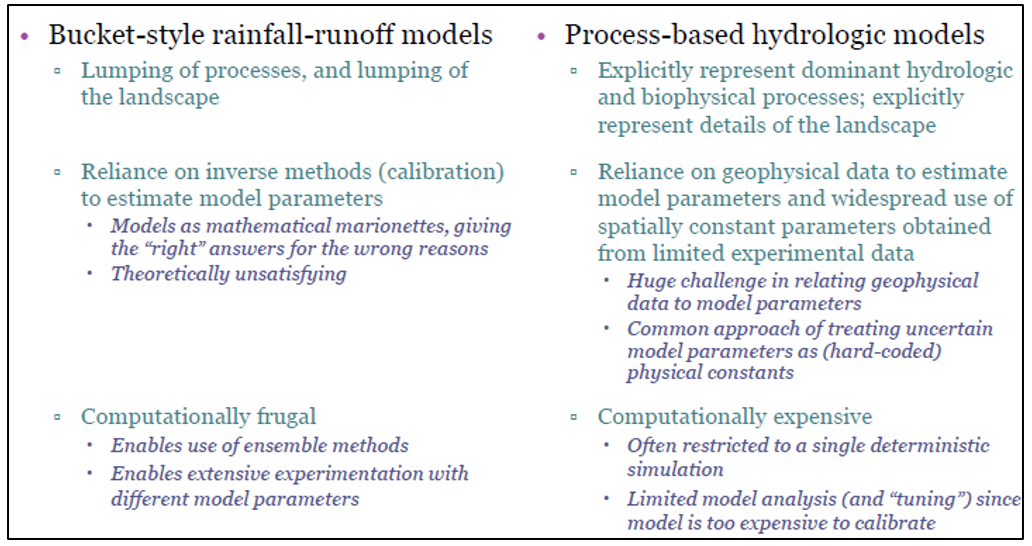
- Simple bucket lumped models: small number of parameters required, could use inverse methods to infer hydrologic parameters in these models (Table 1). Clark developed FUSE (Framework for Understanding Structural Errors, Clark et al., WRR, 2008) and applied this framework to rainfall runoff models.
- Distributed hydrologic models: much larger number of parameters need to be estimated, precludes simple inverse approaches as applied to lumped models (Table 1).
- Parameter multipliers scale a-priori spatial fields of a priori parameters up and down by calibration, as demonstrated with TOPNET (Bandaragoda et al., JoH, 2004).
- Luis Samaniego (WRR, 2010) proposed use of multiscale parameter regionalization: transfer functions that translate geophysical attributes to model parameters (e.g., pedotransfer functions), with a common set of transfer-function coefficients calibrated across the modeling domain.
- Adaptive Surrogate Model-based Optimization: Random forests or neural networks are used as emulators to estimate the objective function surface using previously evaluated parameter sets, enabling optimization using computationally inexpensive evaluations of the surrogate model (Gong et al., WRR, 2016).
- Andy Wood and others developed Large-sample machine learning emulators (LSE) and dramatically improved parameter estimation across multiple basins. Instead of calibrating one watershed at a time, emulator approaches simultaneously learn relationships across many catchments. Incorporating geophysical attributes in the emulators enables application of the emulators to ungauged basins while smoothing out local calibration artifacts. These surrogate models greatly accelerate optimization compared to repeatedly running computationally expensive process-based models. (Tang et al., WRR, 2025).
- Prediction in ungauged basins benefits from learning across entire continents rather than transferring parameters from individual donor catchments.
Traditional donor-receiver methods applied to ungauged basins often struggle because individually calibrated parameters capture basin-specific peculiarities. Joint learning across thousands of catchments produces more transferable parameter relationships and better regional generalization.
- Differentiable modeling may revolutionize parameter estimation.
Clark highlighted Chaopeng Shen's differentiable modeling framework (Shen et al., NREE, 2023), which combines machine learning (neural networks) with process-based modeling.- Neural networks learn relationships between geophysical attributes and parameters used in the process-based models to predict, for example, streamflow. This is done across the entire modeling domain, allowing information from many locations to be used to infer relationships between geophysical attributes and model parameters. Many of the applications to date are for relatively simple bucket-type models.
- The performance of the process-based model is used to update the relationship between geophysical attributes and model parameters. This is where the differentiable modeling comes in. A loss function is calculated from differences between model predictions and observations (e.g., the difference between simulated and observed streamflow), and derivatives of the loss function with respect to the model parameters provide the information needed to update the neural network.
- The loss-function derivatives with respect to the model parameters are backpropagated through the neural network to update its weights. In this way, the performance from the process-based model is used to infer the relationship between geophysical attributes and model parameters across the entire domain.
- The derivatives needed for differentiable modeling can also be calculated analytically within the process-based models, as shown by Vrugt and Frame (EGUsphere, 2026)
- New model architectures can accelerate hydrologic model development.
- Clark advocates developing standardized "Lego blocks" for hydrologic models. Rather than each modeling group creating unique modular structures, community standards would allow interchangeable components for snow, vegetation, soil, groundwater, and runoff processes, accelerating scientific progress through shared infrastructure.
- Martyn Clark developed the SUMMA (Structure for Unifying Multiple Modeling Alternatives) framework (Clark et al., WRR, 2015). SUMMA incorporates energy and water balance. SUMMA separates process parameterizations from numerical solvers, allowing researchers to independently evaluate alternative hypotheses, improve numerical methods, and test individual model components while maintaining physical consistency.
- The National Water Model is developing an approach to allow multiple models to work together in the same framework, similar to the SUMMA philosophy.
- Hydrologic science remains essential in the AI era.
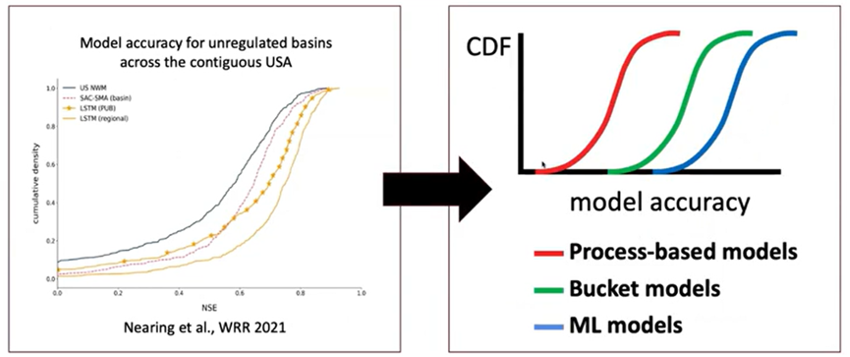
- Grey Nearing’s paper “What Role Does Hydrological Science Play in the Age of Machine Learning? (Nearing et al., WRR, 2020). Where and when is hydrological process understanding valuable? Nearing shows that machine learning models are much more accurate than bucket models which in turn are more accurate than process-based models (Fig. 4). Nearing suggested that the process-based models lack theory.
- Responding to debates sparked by Gray Nearing's paper, Clark argues that hydrology does not lack theory. Instead, hydrologic knowledge is dispersed across decades of field studies and regional expertise. The challenge is synthesizing this knowledge and integrating it with modern machine learning techniques to better parameterize models.
- Clark argues that machine learning should not replace hydrologic theory but instead complement it. Hybrid approaches preserve physically meaningful model structures while exploiting AI's ability to learn complex parameter relationships from large datasets, achieving both improved predictive skill and scientific understanding.
- Agentic AI creates unprecedented opportunities but also introduces "integrity debt."
AI-assisted software development dramatically accelerates code generation, enabling individuals to produce software at scales previously requiring large teams. However, testing, validation, reproducibility, governance, maintenance, and long-term sustainability have not advanced at the same pace. Clark introduces the concept of "integrity debt" to describe this growing imbalance. - Scientific publishing should shift from measuring outputs to evaluating impact.
Reflecting on his experience as Editor-in-Chief of Water Resources Research, Clark notes increasing submission rates and reviewer shortages. He supports the principles of the Declaration on Research Assessment (DORA), encouraging evaluation of scientific impact, innovation, and community contribution rather than relying primarily on publication counts and citation metrics. - Future hydrologists must become AI-literate and work in partnership with AI.
Clark advises students to embrace AI as a collaborative tool. He encourages using AI for coding while requiring students to document how AI was used and how outputs were verified. Success will depend on combining scientific expertise with thoughtful use of AI technologies.