Listen here on Spotify | Listen here on Apple Podcast
Episode released on October 8, 2026
Episode recorded on August 12, 2026
 Layton Schur discusses his direct marketing approach of 24 different vegetables and beef production to reduce groundwater use in the depleting High Plains Aquifer.
Layton Schur is a third generation farmer with a background in agricultural economics from Texas Tech University. He has transitioned from conventional irrigated agriculture to intensive direct to market vegetable gardening in 50 acres and beef production to adapt to water shortages in the High Plains Aquifer.
Highlights | Transcript
- Groundwater depletion drove agricultural innovation in the High Plains Aquifer.
- Layton Schur explains that declining groundwater availability on the Texas High Plains forced him to rethink the traditional irrigated row-crop model. As irrigation capacity dropped from supporting about 300 irrigated acres to only about 100 acres, he shifted toward enterprises that generate substantially greater economic value per unit of water.
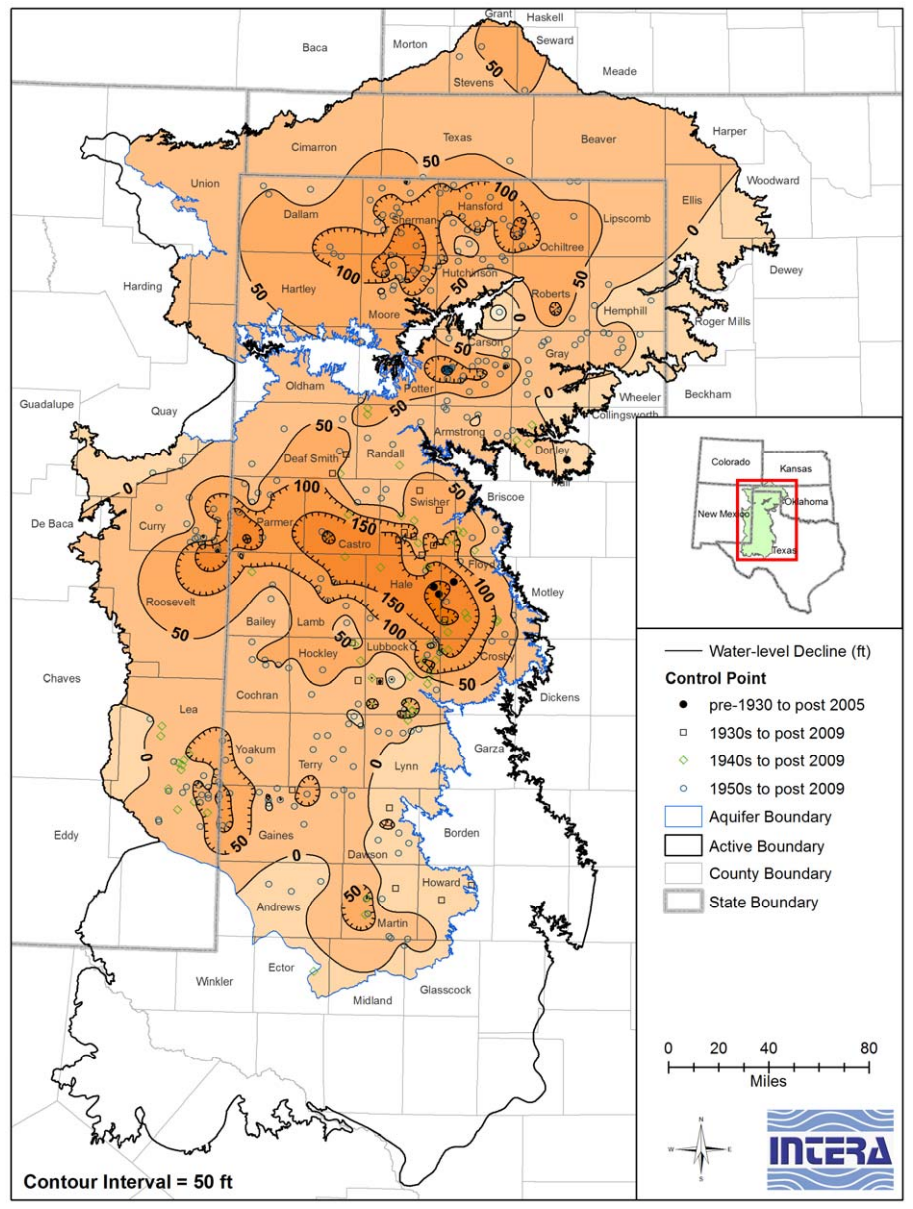
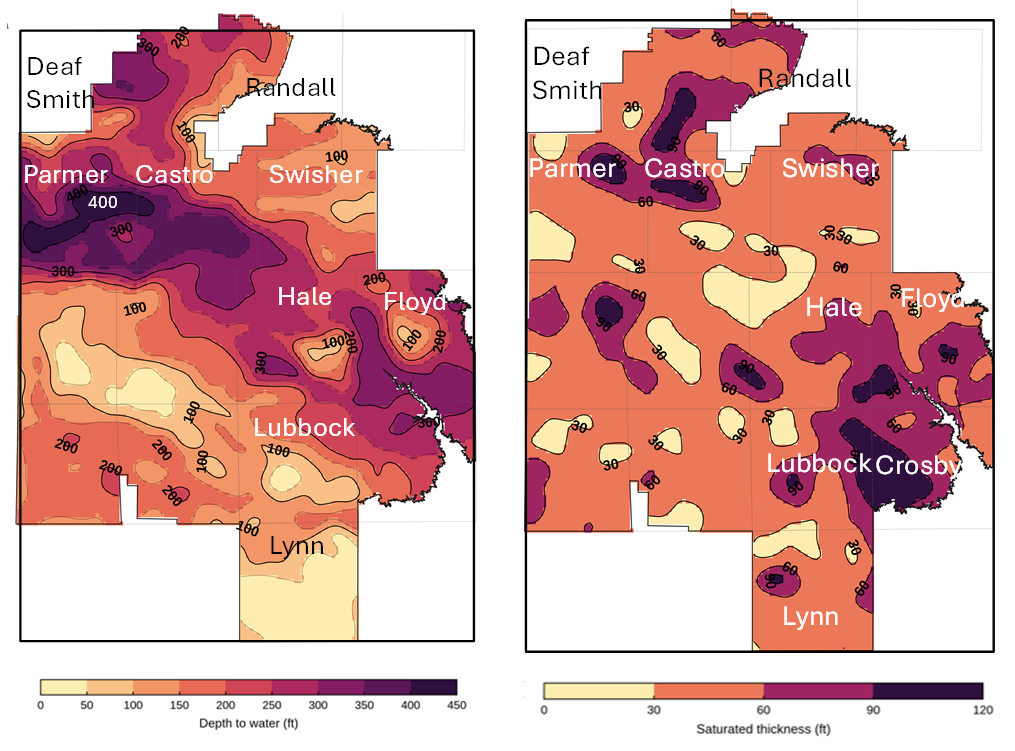
- The water table has declined by more than 150 ft in a large part of Hale County where Layton Schur’s farm is located since predevelopment to 2010 (Fig. 1a). Layton noted that some of his wells went dry in the past few years. Typical well depth on his farm is ~300 ft.
- The remaining aquifer saturated thickness ranges from <30 ft up to 120 ft (Fig. 1b).
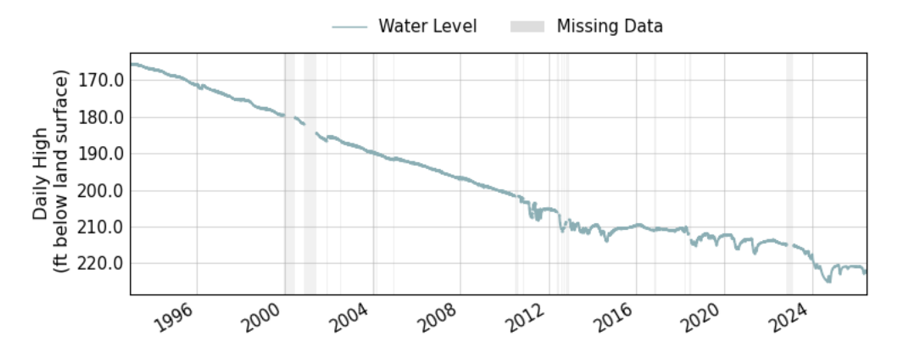
- Groundwater level declined by ~50 feet from 1992–present in a monitoring well near Plainview in Hale County (Fig. 2).
- Value per acre-inch of water became the guiding business principle.
Rather than focusing solely on conserving water by pumping less, Layton asked how each acre-inch of water could generate the highest return. This philosophy led him toward intensive vegetable production with direct marketing, where the economic return per unit of irrigation greatly exceeds traditional crops, such as cotton or grain sorghum.- Layton’s father also increased return on investment for water by growing seed millet and seed sorghum which doubled the returns over traditional corn or cotton.
- Layton has been recognized for conservation and water-saving farming practices in the Texas High Plains. He has tried various sensors for soil moisture but finds that 1.5 inches/week is required for vegetable taste.
- Direct marketing also transformed the economics of cattle production.
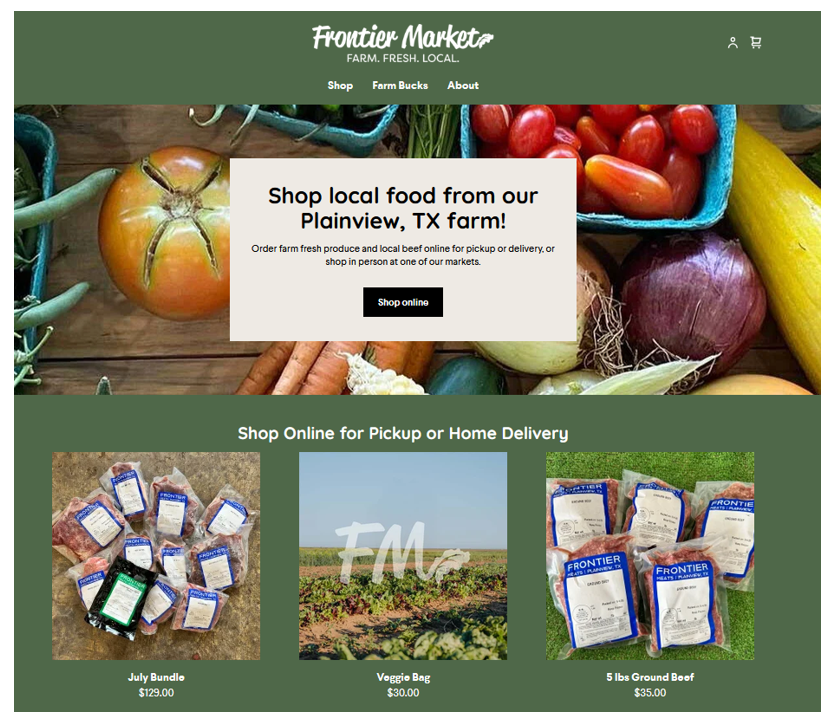
Beginning in 2019 by selling beef directly to consumers through Facebook Marketplace, Layton discovered that eliminating intermediaries dramatically increased profitability. This success eventually led to opening the store front Frontier Market in Plainview, allowing him to capture value throughout the supply chain (Fig. 3).- A small hobby garden evolved into a 50-acre intensive vegetable enterprise.
What started as a 900-square-foot garden expanded rapidly into a highly productive drip-irrigated vegetable farm supplying multiple communities. The transition illustrates how specialty crops can provide viable alternatives for regions facing declining irrigation supplies. - Ultimately, he would like to focus on a 35-acre plot for vegetables and surround it with 165 acres of cover crop to reduce wind erosion, etc. He would rotate the vegetable garden every few years.
- Drip irrigation maximizes both water efficiency and crop quality.
All vegetables are grown under drip irrigation, with water applications managed primarily to maintain consistent crop quality and flavor rather than simply maximizing yields. Layton emphasizes that premium taste is the foundation of successful direct marketing. - He uses about 1/10th of an acre for a green house which he uses mostly to germinate plants. This includes 30 x 120 ft tunnels covered with plastic.
- A small hobby garden evolved into a 50-acre intensive vegetable enterprise.
- Local markets require understanding consumer preferences.
Through experimentation with more than 40 different vegetables, Layton learned that demand varies considerably among nearby cities. Plainview, Lubbock, and Amarillo each exhibit distinct consumer preferences, requiring producers to tailor production to local markets rather than relying on generalized recommendations. He has refined vegetable production to 24 vegetables which he supplies throughout the year.- The mostly Hispanic customers in Plainview like tomatoes, cilantro, and onions.
- Strawberries have been very successful, and he produces up to 1200 lbs/week.
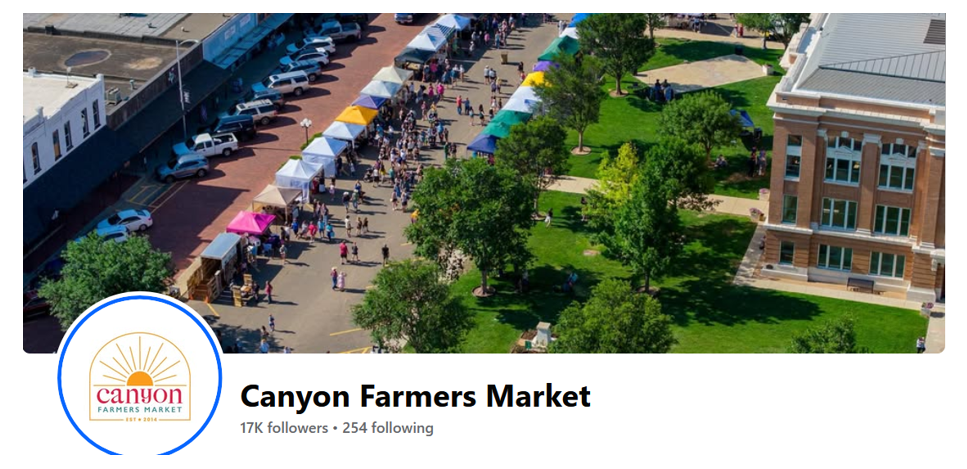
- Farmer’s markets in Lubbock and Amarillo provided an opportunity to develop a customer base but the time is limited to 3-4 hr per week and would not accommodate the availability of fresh produce. Frontier Market had up to 400–600 customers at Canyon Farmers Market (Fig. 4).
- Freshness provides local producers with a competitive advantage.
Locally grown produce, particularly lettuce, can remain fresh for three to four weeks because it avoids long-distance transportation. Layton argues that freshness and flavor—not necessarily organic certification—represent the strongest competitive advantages of local food systems. He selected salanova lettuce from Johnny Seeds which doubles the shelf life of lettuce. - He had only 2% waste in 2025. The only waste he had was related to what he did not pick on the farm.
- Marketing is more important than production.
One of Layton’s strongest messages is that about 70% of a successful specialty farming business is marketing. Many farmers excel at production but struggle to build distribution networks and customer relationships, which ultimately determine business success. - It would be great to develop a market with local schools, like the School Dinners program that Jamie Oliver popularized in the UK.
- Layton also has a "You Pick" program to encourage people to pick vegetables in the garden. He would like to promote an On Farm Meal for VIPs to generate more interest in locally grown food.
- Although Community Supported Agriculture (CSAs) are popular in many parts of the U.S., the customers in the High Plains were reluctant to commit to eating so many vegetables within a week or two.
- Adding value often generates greater returns than increasing production.
Simple processing—cutting watermelons, making pickles, jams, or Bloody Mary mix—can multiply product value several-fold. Layton emphasizes that value-added processing frequently provides higher returns than simply producing larger volumes of raw commodities. - Agriculture must reconnect consumers with food production.
Throughout the interview, Layton stresses that consumers increasingly lack understanding of modern farming. He advocates greater transparency, on-farm experiences, and education to build trust, demonstrate responsible farming practices, and strengthen appreciation for locally produced food.
- Beef production: he changed from cow calf model to feeder heifers, which allows more flexibility to wet and dry years.
- He originally raised Limousines but then transitioned to Limflex.
- Although there is a lot of interest in grass-fed beef, the market is not there and he mostly finishes his cattle with corn.
- Elliot Coleman’s book titled "Holistic Management: A Commonsense Revolution to Restore Our Environment" is very helpful for understanding the holistic approach to agricultural management, including livestock and vegetables.
- Layton also recommends Allan Savory’s book titled "Holistic Management, Third Edition: A Commonsense Revolution to Restore Our Environment."
- West Texas can support year-round local food production.
Despite its semi-arid climate, Layton demonstrates that with crop sequencing and careful management, vegetables can be harvested nearly every week of the year. This challenges common perceptions that local food production is only seasonal in the High Plains.- Mechanization should improve labor productivity rather than replace people.
Although vegetable farming remains labor intensive, Layton selectively invests in affordable equipment, such as transplanters and specialty harvesters that improve employee productivity and quality of life while retaining a local workforce. - Developing a workforce has not been too difficult. He employs 10–12 people year round and they live within about 5 miles of the farm. They work 8–5 pm and can take home extra vegetables which ensures that they are interested in the products they produce.
- Family adaptability has been critical to business success.
Layton credits not only his own willingness to innovate but also his parents' readiness to abandon long-established production practices. Their acceptance of a fundamentally different business model enabled the transition from commodity agriculture to diversified local food production. Layton’s father paved the way by being an active member of the Texas Alliance for Water Conservation and focusing on high value seed millet and seed milo.
- Mechanization should improve labor productivity rather than replace people.
- The future of the High Plains depends on producing food rather than commodities.
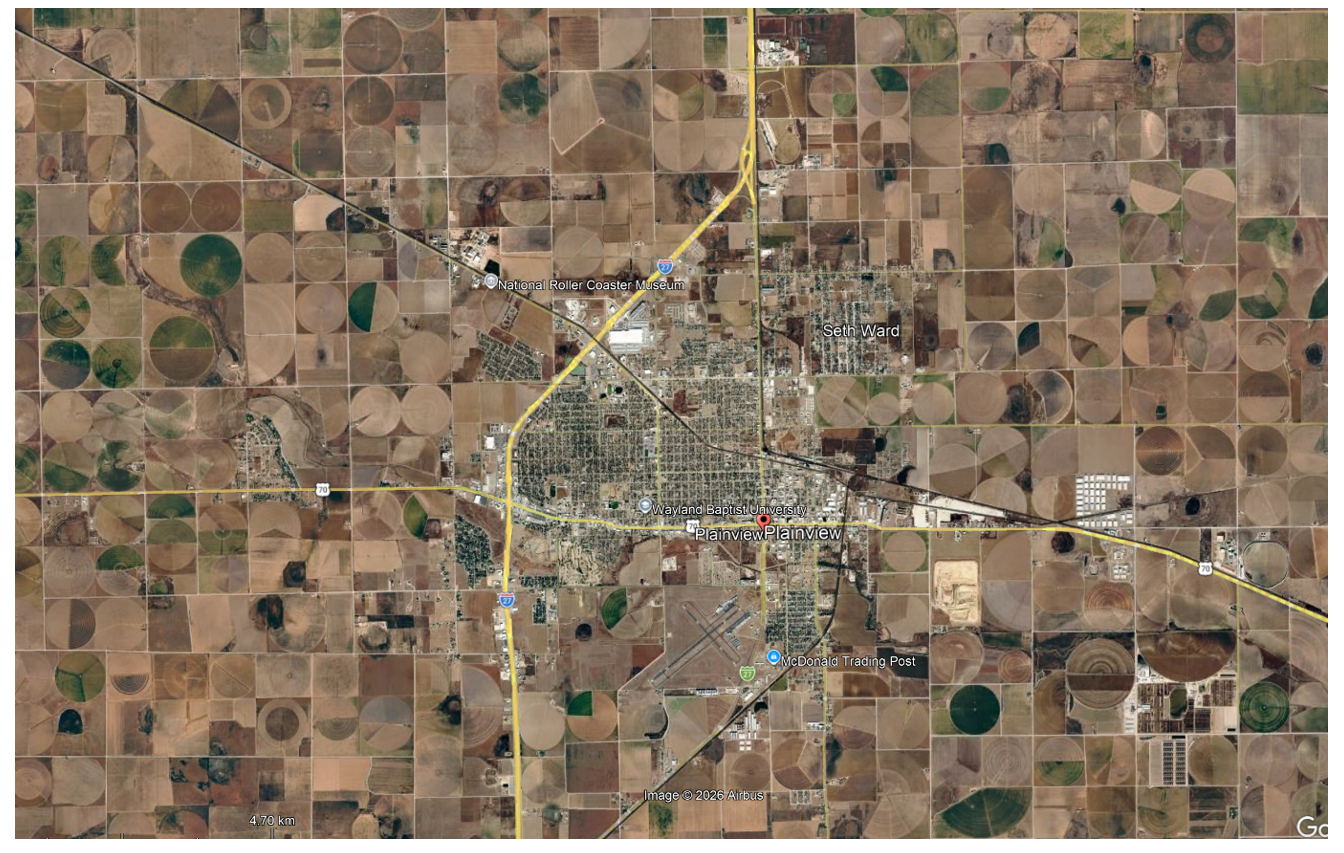
Layton argues that the region should transition away from producing primarily feed grains and biofuel crops toward higher-value food products that require less water but generate greater profitability. Such a shift could improve both water sustainability and farm viability.- Groundwater is declining as shown by center pivots that only irrigate parts of the circles (Fig. 5).
- Profitability is essential for generational succession.
Layton believes the greatest challenge facing agriculture is creating businesses profitable enough for young people to inherit and operate. Smaller, diversified farms producing high-value crops may offer more realistic opportunities for future generations than increasingly capital-intensive commodity farming. - Layton’s farm represents a compelling example of how declining groundwater availability can drive innovation rather than decline. His experience suggests that combining water-efficient production, diversified enterprises, direct marketing, value-added processing, and local food systems can create a profitable and resilient agricultural model for the future of the Texas High Plains. There is room for expansion and Layton encourages other farmers to adopt his model throughout the High Plains.